Home/Articles/Export & Markets
Export & MarketsOman Tissue Paper Market: A Guide for Tissue Machine Buyers and Manufacturers
Oman pays USD 1,624 per tonne for imported tissue — among the highest in the Middle East. That's not a price-sensitive market. Here's what machine buyers need to know.
The Tissue Industry Review·23 Jul 2026·6 min read

A Market That Pays for Quality
Oman does not buy tissue on price. In 2024, Oman's average tissue import price was USD 1,624 per tonne — among the highest in the entire Middle East region. For context, Saudi Arabia averaged USD 1,179 per tonne and the UAE USD 1,304 per tonne. Oman was paying more per tonne of imported tissue than almost any other country in the region.
This is not an accident. It is a market signal. When a country consistently pays a premium for imported tissue, it is telling you something about the quality standard its buyers expect — and about the opportunity for manufacturers who can meet that standard locally.
Oman's tissue and hygiene paper market is projected to reach 134.1 million kg by 2030, growing at 1.9% volume in 2026, driven by the country's expanding tourism sector and rising per capita consumption of 25.2kg per year. The Sultanate's Vision 2040 agenda — focused on economic diversification and reducing oil dependence — has accelerated investment in manufacturing and hospitality infrastructure, both of which are direct drivers of tissue demand.
For a tissue machine buyer or manufacturer evaluating Oman as a market, the starting point is not "how cheap can I produce?" It is "can I produce at the quality standard this market is already paying for?"
What Drives Tissue Demand in Oman
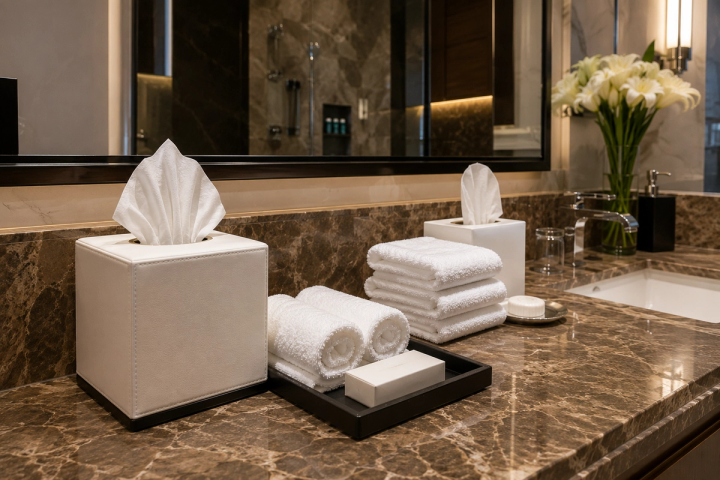
Oman's tissue demand is shaped by three converging forces: tourism growth, hospitality infrastructure expansion, and rising household income.
Tourism is the most significant near-term driver. Oman has invested heavily in positioning itself as a premium Gulf tourism destination — luxury resorts, heritage tourism, eco-tourism, and cruise infrastructure across Muscat, Salalah, and the coastal regions. Every hotel room, restaurant, spa, and hospitality facility requires consistent tissue supply across napkins, toilet rolls, facial tissue, and hand towels. Premium hospitality buyers in Oman do not accept inconsistent quality — their guests are international travellers with high expectations.
Household consumption is also rising. Oman's young, urbanising population — with increasing disposable income and growing hygiene awareness — is driving retail tissue demand across supermarkets and modern trade channels. Per capita consumption of 25.2kg per year reflects a market where tissue is already an established household essential, not an aspirational purchase.
The combination of premium hospitality demand and growing household consumption creates a market where manufacturers need to serve multiple quality tiers simultaneously — luxury hotel napkins at one end, retail toilet rolls at the other — with consistent quality throughout.
The Manufacturing Opportunity
Oman imports 12,000 tonnes of tissue annually. Domestic converting capacity is limited, meaning the majority of finished tissue products — napkins, toilet rolls, facial tissue, hand towels — are either imported as finished goods or converted from imported parent reels.
For an entrepreneur or manufacturer establishing a converting operation in Oman, the business case is straightforward: significant import dependence, premium quality expectations, government support for manufacturing investment under Vision 2040, and a tourism sector that guarantees consistent institutional demand.
The machine categories most relevant to the Omani market:
Paper napkin machines — for the hospitality and food service segment. Muscat's restaurant and hotel density creates consistent napkin demand across quality tiers. Premium printed napkins for luxury hospitality, standard white napkins for mid-tier food service — both segments exist and both are growing.
Face tissue machines — Oman's hospitality sector has established demand for premium facial tissue, particularly in hotel rooms and luxury hospitality settings. Face tissue machines producing pop-up format facial tissue serve this segment directly.
Toilet roll rewinders — for household and institutional supply. Hotels, residential buildings, offices, and healthcare facilities all require consistent toilet roll supply. High-speed JRT and HRT rewinders serve the large-format institutional segment.
6 color flexographic printing machines — for manufacturers targeting the premium hospitality segment with designer and patterned napkins. Given Oman's premium import price profile, a manufacturer who can produce printed napkins locally — at the quality level Omani hospitality buyers are already paying for — has a direct import substitution opportunity.
For full machine specifications across all categories, visit birlahitechmachines.com and toiletrollmachines.com.
The Machine Quality Question — Why It Matters More in Oman
Oman's premium import price profile creates a specific challenge for tissue machine buyers that does not apply in lower-price markets: the machine you buy must be capable of producing at the quality level the market is already paying for.
A budget machine producing inconsistent output — fold variation, print drift, quality fluctuation across a long run — cannot serve an Omani luxury hotel. The buyer will not accept it. In a market where tissue is imported at USD 1,624 per tonne, a locally-produced product that does not match that quality standard does not displace the import. It simply fails to sell.
This is where component specification becomes a business-critical decision, not just a technical one.
Chinese budget machines — which dominate the entry-level tissue machine market across the Gulf — are built to a price point. The component choices that make them affordable are the same choices that limit their output consistency over time. Bearings that wear faster cause fold drift. Control systems that cannot be serviced locally cause extended downtime. Pneumatic components that degrade under continuous cycling cause quality variation that the Omani hospitality buyer will notice.
A machine built with Japanese bearings — FYH, Nachi — holds its tolerance over time. A machine running Siemens PLC and HMI automation can be diagnosed and serviced by any qualified engineer in the region. A machine with European pneumatic components maintains consistent cycling performance across years of continuous operation.
In a market like Oman — where the quality bar is set by premium imports at USD 1,624 per tonne — the machine specification is not a day-one cost decision. It is a market access decision. The wrong machine locks you out of the market you are trying to serve.
For a complete guide to evaluating machine specifications, read What's Actually Inside Your Tissue Machine on The Tissue Industry Review.
What to Verify Before Importing a Machine for Oman
The standard verification framework applies with additional weight in a premium market like Oman.
Ask for bearing specifications by name. FYH and Nachi are Japanese manufacturers. NSK and FAG are also acceptable. Generic or unspecified bearings are not — in a market where quality consistency is the entry requirement, bearing grade is not a detail to overlook.
Confirm automation serviceability in the region. Siemens has a service presence across the Gulf. If the machine runs a proprietary Chinese control system, find out where the nearest service engineer is and what the typical response time is for a fault that requires on-site intervention.
Ask about commissioning. Does the manufacturer's own engineer travel to Oman for installation? In a market where getting the machine set up correctly from day one directly affects your ability to serve premium buyers, on-site commissioning by the manufacturer's engineer is not optional.
Request samples at production speed. Ask the manufacturer to produce sample napkins or tissue at their quoted production speed and send them to you. Evaluate print registration, fold consistency, and dimensional accuracy. These samples tell you more about real machine capability than any specification sheet.
Check the warranty period and coverage. The minimum in India is 12 months. The longest available is 18 months, covering all mechanical and electrical components. In a market as demanding as Oman, the warranty period is a meaningful indicator of the manufacturer's confidence in their own product.
For the complete buyer verification framework, read How to Find the Best Paper Napkin Machine Manufacturer in India on birlahitechmachines.com.
Indian Machines in Oman — An Established Presence
Indian tissue machine manufacturers have an established supply relationship with Oman's converting sector. Machines from Indian manufacturers — including face tissue machines, napkin machines, and rewinders — are running in Omani converting operations, producing for both the local market and export.
The face tissue category is particularly notable. India's first face tissue machine — producing pop-up format facial tissue for the premium hospitality and retail segment — has found a natural market in Oman, where hospitality-grade facial tissue is a consistent requirement across the luxury hotel sector.
The Indian manufacturers worth evaluating for the Omani market are the ones who have built a track record in premium output — machines that can consistently produce at the quality level Oman's buyers are already paying for in imports. That track record is verifiable: ask for references in Oman or neighbouring Gulf markets, ask for samples, ask for the component specification that makes the output consistent.
Further Reading
- What Raw Materials Does a Paper Napkin Machine Need? — raw material quality guide
- UAE and Dubai Tissue Paper Market Guide — neighbouring market context
- papernapkinmachines.com — 6 Color Flexographic Paper Napkin Machine
- birlahitechmachines.com — Full product range
The Tissue Industry Review is an independent editorial publication covering the tissue conversion and paper products manufacturing sector in India and globally. Market data sourced from Statista, IndexBox, and MENA industry analysis.
/ RELATED ARTICLES
Keep Reading

Export & Markets
UAE and Dubai Tissue Paper Market: A Guide for Tissue Machine Buyers and Manufacturers
The UAE has the highest per capita tissue consumption in the Middle East, a booming hospitality sector, and re-export reach to the US and UK. Here's what machine buyers need to know.
22 Jul 2026· 6 min read

Export & Markets
Nigeria Tissue Paper Market: A Guide for Tissue Machine Buyers and New Manufacturers
Nigeria is Africa's largest tissue paper market - 43% of continental consumption, growing at 5.8% annually, with domestic production meeting just 7% of demand. The manufacturing gap is enormous.
18 Jul 2026· 6 min read