Industry News
The Invention That Built India's Tissue Machine Industry
In 1982, one man built a machine nobody in India had built before. The President recognised it. The government certified it. An entire industry grew from that workshop.
The Tissue Industry Review·24 Jul 2026·6 min read
Before the Machine Existed
In the years before 1977, India had no domestic tissue paper conversion machine industry to speak of. Tissue converting equipment — machines that take large parent reels of tissue paper and fold, cut, and package them into finished napkins, toilet rolls, and facial tissue — was imported. European machines set the standard. Indian manufacturers who wanted to enter the tissue business had to import the equipment to do it, at European prices, with European lead times, and with no local support infrastructure when something went wrong.
The idea that India could build its own tissue conversion machines — machines capable of competing with imported equipment — had not been demonstrated. It would take one inventor, working in a workshop in Delhi, to demonstrate it.
1977 — The First Machine
In 1977, Late Shri Pushkar Lal Birla, operating under the name Paper Converting Machines, supplied India's first online slitting toilet roll machine to Sehgal Paper Mills.
This was not a modification of an existing design. There was no existing Indian design to modify. It was a machine built from the ground up — the first demonstration that India could produce tissue conversion equipment domestically.
The machine worked. Sehgal Paper Mills ran it. And the idea that had not been demonstrated — that India could build its own tissue machines — was demonstrated.
1982 — The Invention That Changed Everything
Five years later, in 1982, Shri P.L. Birla built something more significant: India's first automatic paper napkin folding machine with automatic folding.
The machine solved a problem that had no domestic solution. Napkin folding in India at the time was largely manual — labour-intensive, slow, inconsistent. A machine that could fold napkins automatically, at production speed, with consistent output, was a category that simply did not exist in Indian manufacturing.
Shri P.L. Birla built it. Paper Converting Machines, his Delhi-based operation, became the first company in India to produce an automatic paper napkin folding machine.
The invention did not go unnoticed.
Two Government Recognitions — Four Years Apart
In 1986, the All India Manufacturers Organisation presented Shri P.L. Birla with the Bharat Ratna Vishvesvaraya Award — named for Sir M. Visvesvaraya, the legendary Indian engineer and statesman. The award was presented by the Hon'ble Giani Zail Singh, President of India, to M/s. Paper Converting Machines.
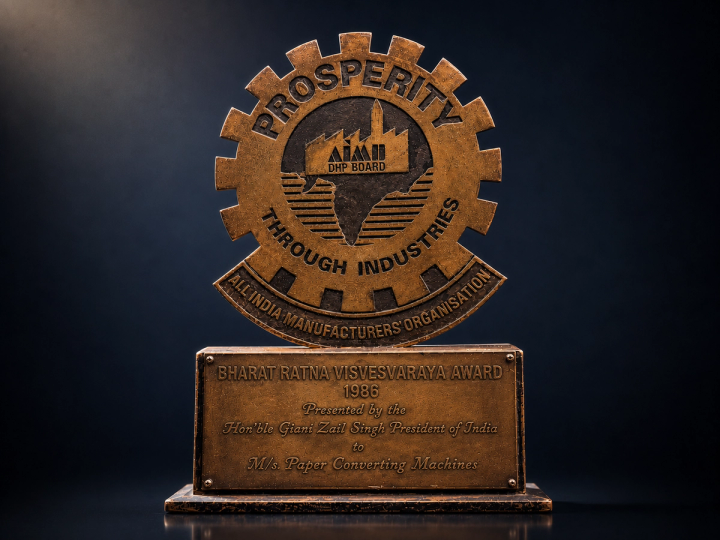
The physical trophy — a brass medallion bearing the inscription "Bharat Ratna Visvesvaraya Award 1986, Presented by the Hon'ble Giani Zail Singh President of India to M/s. Paper Converting Machines" — remains in the family's possession today.
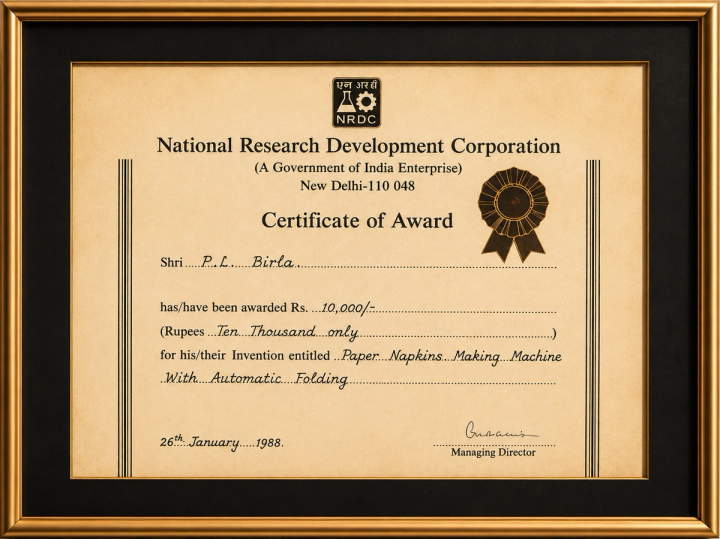
Two years later, on 26th January 1988, the National Research Development Corporation — a Government of India enterprise — issued a Certificate of Award to Shri P.L. Birla, awarding Rs. 10,000 for his invention entitled "Paper Napkins Making Machine With Automatic Folding."
Two separate government bodies. Two separate recognitions. The same invention.
The NRDC certificate and the Bharat Ratna Vishvesvaraya Award trophy are primary documents — physical evidence of a moment in Indian manufacturing history that has never been formally recorded in the industry's own literature.
The Industry That Grew From One Workshop
What happened after 1982 is the part of India's tissue machine industry history that is widely known within the trade but rarely spoken about publicly.
Paper Converting Machines was not just a manufacturing operation. It was, for a significant period, the place where India's tissue machine industry learned its craft. The salesmen who sold India's first napkin machines learned the business there. The foremen who understood how these machines were built learned it there. The engineers and workers who understood tissue machine mechanics at the component level were trained there.
When those people left — to start their own companies, to join new operations, to build on what they had learned — they took that knowledge with them. The tissue machine manufacturers who emerged in the years and decades after 1982 did not build their technical foundations from scratch. They built them from what had been established at Paper Converting Machines.
This is not a contested claim within the industry. It is the origin story that the Indian tissue machine sector shares — whether or not it is formally acknowledged.
1999 — A Deliberate Departure
In 1999, Ashwani Birla — son of Shri P.L. Birla — made a decision that would define the second chapter of this family's contribution to the industry.
He left.
Not because the industry his father had built was failing. But because he saw what it had become — an industry that had learned to replicate the original designs and compete on price — and he wanted to build something different. Faster machines. More durable construction. Higher performance specifications. Machines that could stand against European imports not just on price but on output quality.
He founded Birla Hi-Tech Machines in Okhla, Delhi and later shifted operations to Faridabad, Haryana. The rest of the industry, by then, was comfortable. Birla Hi-Tech Machines was not interested in comfortable.
The machines that followed reflected that decision: India's first straight-type automatic napkin folding machine, India's first coreless toilet paper log rewinder, India's first C-fold paper towel machine, India's first double deck machine, India's first 4-6 colour printing machine with ceramic rollers. Thirteen India Firsts between 1977 and 2026 — continuing a tradition of innovation that began in a Delhi workshop in 1977.
2018 — The Original Company Dissolves
In 2018, Shri P.L. Birla dissolved Paper Converting Machines.
The company that had invented India's first automatic paper napkin folding machine, that had been recognised by the President of India and the National Research Development Corporation, that had trained the craftsmen and salesmen and engineers who went on to build much of the Indian tissue machine industry — closed.
The industry it created did not.
Every tissue machine manufacturer in India today who traces their lineage to that original Delhi workshop — through employment, through training, through the knowledge that passed from one generation of craftsmen to the next — is operating on a foundation that one man built in 1982.
Why Origin Matters
The tissue machine industry in India is not short of manufacturers. It is short of manufacturers who can tell you where their knowledge came from — specifically, verifiably, with documents to support the claim.
The Birla family can. The Bharat Ratna Vishvesvaraya Award trophy exists. The NRDC certificate exists. The machines supplied to Sehgal Paper Mills in 1977 existed. The 13 India Firsts between 1977 and 2026 are documented.
When a tissue machine manufacturer claims experience, ask them to trace it. The trail, for most of India's tissue machine industry, leads back to one place.
Birla Hi-Tech Machines — founded in 1999, with machines running in 22 countries, with an 18-month warranty, with FYH and Nachi Japanese bearings and Siemens automation — is the direct continuation of that lineage. Not the only company to emerge from it. The one that kept innovating.
birlahitechmachines.com The Tissue Industry Review
The Tissue Industry Review is an independent editorial publication covering the tissue conversion and paper products manufacturing sector in India and globally. Primary sources: Bharat Ratna Vishvesvaraya Award trophy (1986), NRDC Certificate of Award (1988), Birla family records.
